


Royal Arrow: Merge & Match
4.3813.00 Reviews
App Specs
- Version
- 1.0.2
- Updated On
- License
- Free
- Downloads
- 100,000+
- Developer
- Харитония Илиева
- Categories
- Casual
- Platform
- Android
Screenshots


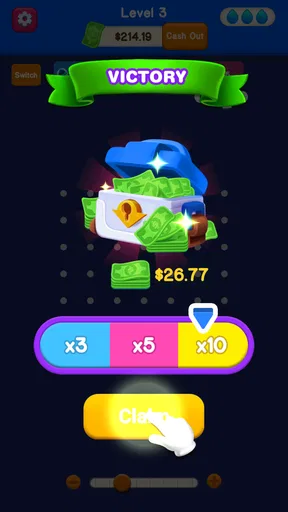
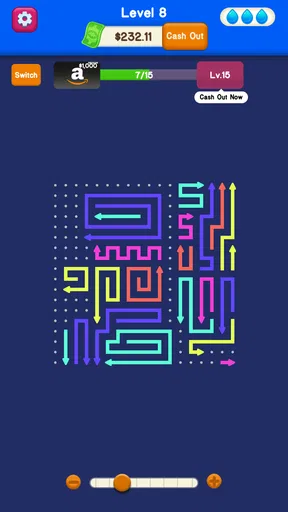
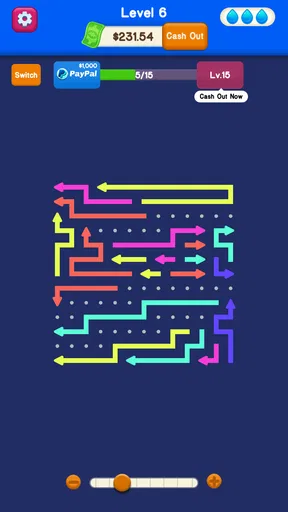
 Analysis by AppCompare
I went into Royal Arrow: Merge & Match expecting a light puzzle for spare moments, and that is exactly where it fits best. The first move is easy to understand: I look at the arrows on the board, find matching possibilities, and combine them with a tap or drag. The pleasure comes from watching a small decision turn into a cleaner board, then noticing that the next move has become available because of it. It is simple, but not empty.
This is a casual game from Харитония Илиева, available for free and aimed at players aged Everyone 10+. It is also designed for offline play, which makes it a practical choice when I want something that does not depend on a connection. The current version is 1.0.2 and it runs on Android 6.0 or later. Those details matter less than the feel of a round, though, so I spent more time judging how well the matching and merging loop holds my attention.
Why the first move is more important than it looks
The opening action in Royal Arrow is deliberately approachable. I do not need to learn a long rule set before playing; I can begin by scanning the visible arrows and deciding which pair appears most useful. That low entry barrier is one of the game’s strongest qualities. It works when I have only a minute, but it also leaves enough room for a more careful approach when the board starts demanding better choices.
What makes the first move interesting is that matching is not only about removing an obvious pair. A move changes the shape of the remaining puzzle, so I try to think about what the board will look like immediately afterward. If I take the easiest match without considering the spaces it opens or blocks, I can make the next decision less comfortable. The useful habit is to pause for a brief scan before acting rather than tapping the first available option.
I found that this small pause creates a pleasant difference between random play and deliberate play. A rushed move may still produce progress, but a thoughtful one feels more rewarding because I can see the chain of consequences. That is a good fit for people who enjoy compact logic puzzles but do not want a complicated strategy game with a heavy tutorial or a large collection of systems to manage.
The arrow theme also gives the board a clear visual language. Arrows naturally suggest direction, so I pay attention not only to whether two pieces can be matched but also to how their orientation affects my reading of the board. I would not call the game difficult to understand, yet the symbols encourage me to look twice before committing. That extra moment is where much of the game’s personality comes from.
A useful way to read the board
My best results came from separating the board into immediate matches and future space. First, I look for a move that creates room. Then I check whether the resulting arrangement exposes another useful combination. This is more reliable than chasing the most attractive merge every time, because an apparently valuable action may leave awkward pieces in the way.
Worth Reading Before You Choose

EA SPORTS FC Mobile 26 Is a Bigger Football Game, but It Takes Time

Flipboard Shows What News Apps Must Do Beyond the Feed

Switching to Android Auto Means Rethinking Your Driving Routine

Google Calendar Makes a Crowded Week Easier to Manage

Ludo King Makes the Most of the Minutes Between Plans

Baby Panda World Brings Quick Play to Modern Phones, but Its Game Library Feels Busy
That approach is especially helpful during a short session when I am playing one-handed or while waiting somewhere. I can make a quick plan without needing to memorize a complicated sequence. The game rewards attention, but it does not demand the kind of uninterrupted concentration I would give a long-form strategy title.
There is also a practical trade-off here. Players who want immediate, constant action may find the opening too calm. Royal Arrow asks me to observe first, and its satisfaction grows from arranging the next opportunity rather than from rapid tapping. If your preferred casual games are reaction tests, endless runners, or match games built around bright bursts of activity, this may feel restrained.
The feedback rhythm: action, response, and the next decision
The core feedback rhythm is easy to follow. I choose a match, the arrows respond, the board changes, and I immediately begin looking for the next possibility. That sequence gives each move a clear purpose. Even when I make a less-than-perfect choice, I understand what happened because the board itself shows the result.
This clarity is important in a puzzle game. I do not want to wonder whether a move counted or why the arrangement changed. Royal Arrow’s appeal comes from the direct connection between my action and the visible response. The feedback is not buried under a complicated interface, so I can stay focused on the puzzle rather than on controls.
The rhythm also explains why a short round can become another round. A successful merge gives me a small sense of completion, but it also reveals a new problem. The reward is therefore double-sided: I enjoy the move I just made, then I become curious about whether I can improve the next one. That is a more thoughtful loop than simply waiting for a timer or chasing a score without understanding the board.
For me, the most satisfying moments happen when a move solves two problems at once. I may clear a match and create a better route through the remaining pieces, or make room that turns a previously awkward arrangement into an obvious one. These moments are not guaranteed, which is good. If every action produced a perfect cascade, the game would lose the need for observation.
How to avoid playing on autopilot
A simple technique is to identify one “safe” move and one “setup” move before choosing. The safe move gives immediate progress. The setup move may not look as rewarding, but it can improve the position for later. Comparing those two options keeps me from treating every visible match as equally valuable.
I also try not to restart the moment a board becomes less tidy. A messy position can still contain the better solution, and abandoning it too quickly removes the chance to learn how the arrangement behaves. When I do reset, I prefer to remember the decision that caused the problem. That turns a failed attempt into a small lesson instead of a meaningless interruption.
This is one of the game’s less obvious strengths: it can support a quiet learning loop without making the experience feel like homework. I begin with recognition, make a move, observe the consequence, and adjust. The process is compact enough for casual play, but it still gives me a reason to improve rather than merely repeat.
The limitation is that the feedback depends on my own interest in reading the board. Players who need elaborate effects, strong narrative reactions, or a large reward presentation after every action may find the experience modest. Its feedback is primarily functional and puzzle-focused. That restraint helps the game stay relaxing, but it also means the presentation may not satisfy someone looking for spectacle.
What counts as a reward in a quiet puzzle
Royal Arrow does not need a dramatic prize after every match to feel rewarding. The main payoff is the improved board: fewer obstacles, more room, and a clearer route toward the next merge. I like that the game makes progress visible through the puzzle itself. The reward is something I can use immediately, not just a badge or a number that sits outside the action.
There is a second reward in making a better decision than I made a moment earlier. If I spot that a careless match would have left a difficult arrangement, then choose a slower but more flexible move, I feel that improvement directly. This gives the game a gentle sense of mastery. I am not only clearing pieces; I am becoming better at predicting the consequences of a match.
That makes it suitable for several everyday situations. I can play during a short break, on a journey where I want an offline option, or at the end of the day when I want something more engaging than passive scrolling. Because the game is based on compact decisions rather than a long story, I can put it down without feeling that I have abandoned a major objective.
Offline access is particularly useful in that context. I can treat it as a dependable puzzle for places where a connection is inconvenient. I would still recommend checking the game’s current behavior on your own device before relying on it for a specific trip, but the offline design is clearly part of its identity and makes it more flexible than games that require continuous access.
The free price also lowers the risk of trying it. I can install it as a casual experiment rather than committing to a paid purchase. That does not automatically make it the best choice for everyone, though. Free games still compete for attention, and Royal Arrow earns mine only when I am in the mood for calm visual problem-solving rather than a more energetic or content-heavy experience.
Who will get the most from the reward loop
I would recommend it to someone who enjoys matching puzzles but wants a slower, more spatially aware variation. It is a good fit for players who like to inspect a board, make a choice, and see the arrangement gradually improve. It also suits people who prefer games that can be enjoyed in short bursts without requiring a social account, a story commitment, or a long uninterrupted session.
I would be more cautious recommending it to players who need a deep progression system, competitive multiplayer, or a steady stream of new mechanics. The confirmed identity of this game is a focused casual puzzle, and that focus is both its appeal and its boundary. If you are looking for a large adventure, a fast arcade challenge, or a complex planning game, another category will probably serve you better.
The age guidance of Everyone 10+ gives it a broad audience, but the real question is temperament rather than age. A patient player may enjoy the small decisions, while someone who dislikes repetition may lose interest even if the rules are perfectly understandable. I would introduce it to a friend as a “quiet board-clearing game,” not as an all-purpose mobile title.
Resetting the session without losing the lesson
Every puzzle loop needs a reason to stop and a reason to begin again. In Royal Arrow, the reset matters because it lets me test a different reading of the same kind of problem. I may restart after reaching an uncomfortable position, but the next attempt is not identical in my mind: I now know which move created tension and can look for another route.
That makes the reset feel more useful than simply pressing replay. A good restart is a small experiment. I change the order of two matches, protect an open area, or delay a tempting merge to see whether the board becomes easier to manage. This is one of the strongest ways to get more from the game without inventing extra goals that are not part of its design.
There is a realistic limit, however. If I play for too long without a break, the loop can become predictable because the basic action remains the same: inspect, match, merge, and reassess. The game is better at providing a clean mental pause than at sustaining a marathon session. I get more enjoyment by stopping after a satisfying attempt and returning later than by forcing myself to continue after the decisions begin to blur together.
For a daily routine, I would use it as a five-minute reset between demanding tasks. I can open it, make a few careful moves, and close it when my attention starts wandering. That use case feels more natural than treating it as a primary gaming destination. The offline format strengthens this role because the game can occupy a small pocket of time without needing preparation.
One practical tip is to restart with a specific question. Instead of thinking, “I will do better,” I ask, “What happens if I preserve this space?” or “Can I delay that obvious match?” A focused experiment makes the next session more interesting and helps me notice the game’s strategic layer. Without that intention, repeated resets can feel like going through the motions.
How it compares with familiar casual alternatives
Compared with traditional match-three games, Royal Arrow feels less dependent on building long chains of identical pieces for immediate visual excitement. My attention goes more toward position, direction, and the order of actions. Someone who enjoys planning a board may prefer this, while someone who plays match-three games mainly for cascades and colorful spectacle may find it less lively.
Compared with endless runners, it is far less demanding physically. I am not reacting to a rapidly changing lane or trying to maintain momentum. That makes it a better choice when I want to relax, but a worse choice when I want adrenaline or a strong sense of speed. The game’s tension comes from committing to a move, not from surviving a fast sequence.
Compared with classic number-merging puzzles, the arrow presentation gives the decision-making a different texture. I am not simply looking for identical values to combine. The directional symbols make me read relationships on the board, so the visual arrangement matters as much as the individual pieces. Players who enjoy spatial organization may find that more appealing than a purely numerical system.
Compared with large puzzle collections, this game is easier to enter because it keeps its central idea in view. The trade-off is variety. A collection title may offer several puzzle formats when I become tired of one, whereas Royal Arrow asks me to find depth in its single matching-and-merging loop. I would choose it for focus and convenience, not for breadth.
My verdict on the complete loop
Royal Arrow: Merge & Match works because its loop is honest. I take an action, receive an immediate board response, gain the reward of a cleaner or more promising position, and then decide whether to continue or reset. The next session begins because I can see another possibility, not because the game needs to overwhelm me with noise.
Its audience is already substantial, with over 100 thousand installs, and the game holds an average rating of 4.2 from around 2.9 thousand ratings. I can understand that reception: the concept is approachable, the offline angle is useful, and the puzzle gives small decisions enough consequence to remain interesting. The developer, Харитония Илиева, has kept the experience centered on its main idea rather than burying it under unrelated systems.
Still, I would not recommend it as a universal pick. If you want a story, rapid reflexes, multiplayer competition, or a large range of modes, you should choose a different casual game. Even within puzzle games, players who need constant novelty may prefer a title that changes its rules more often. Royal Arrow is strongest when I want a contained mental exercise with a calm pace.
For me, the best way to play is to treat each board as a small planning problem. Scan before tapping, compare an immediate match with a space-making move, and use a restart to test one clear idea rather than repeating the same pattern. Follow that approach and the game becomes more than a basic matching exercise. It becomes a compact, relaxing routine that gives me just enough challenge to make another session feel worthwhile.
Pros
- Simple merge mechanics are easy to learn and play casually.
- Short levels make it suitable for quick gaming sessions.
- Progression offers a satisfying sense of improvement over time.
- Bright visuals and clear effects make matches easy to follow.
- Playable without requiring advanced strategy or gaming experience.
Cons
- Repeated merge tasks can become monotonous after extended play.
- Difficulty may feel uneven across later stages.
- Some upgrades can require considerable time or repeated actions.
- Limited variety may reduce long-term appeal for experienced players.
- Frequent reward prompts may interrupt the flow of gameplay.
FAQs for Royal Arrow: Merge & Match
What is Royal Arrow: Merge & Match, and how is the gameplay structured?
Royal Arrow: Merge & Match is a casual puzzle game built around combining matching items and completing arrow-based challenges. During play, you merge or match pieces to create stronger objects, clear objectives, and progress through increasingly demanding stages. The controls are generally simple and suitable for short sessions, although later levels may require more planning, careful positioning, and efficient use of limited moves or available space.
Is Royal Arrow: Merge & Match free to download and play?
The game can generally be downloaded and played without an upfront purchase, but free-to-play titles commonly include optional in-app purchases. These may provide extra resources, boosters, lives, or other conveniences that help players progress more quickly. Advertising may also appear between levels or during reward opportunities. Before downloading, users should check the current store listing for the exact purchase options, advertising policy, and any regional differences.
Does Royal Arrow: Merge & Match require an internet connection?
Royal Arrow: Merge & Match may allow some basic puzzle gameplay while offline, which is useful when traveling or when a stable connection is unavailable. However, features such as advertisements, cloud synchronization, events, leaderboards, account services, or in-app purchases may require internet access. Offline availability can change after updates, so it is best to test the game after installation rather than assuming every feature will work without a connection.
Is Royal Arrow: Merge & Match suitable for children and casual players?
The matching and merging format is easy to understand, making Royal Arrow: Merge & Match accessible to casual players and people who prefer relaxed puzzle games. Nevertheless, parents should review the age rating, advertising, and in-app purchase settings before allowing children to play. Difficulty, timers, reward systems, and optional purchases can influence the experience, so parental controls are recommended on shared or family devices.
What should I know about performance, storage, and progress before installing?
The game is designed for mobile play, but the experience can vary depending on the phone or tablet, operating-system version, available storage, and background applications. Older devices may show slower loading, reduced responsiveness, or occasional instability. It is also wise to check whether progress is connected to an account or cloud service, because uninstalling the app, changing devices, or clearing data may remove local progress if no backup option is available.


